In fact, even if you have read the previous basic skills, you will still feel confused when you don't get started, because these knowledge points are too fragmented, so this chapter will integrate them.
I will take the keyword "AI Tarot Reading" as an example to walk you through how to write high-ranking SEO content.
Article example: https://destinyai.tools/blog/ai-tarot-reading-2025
1. Keyword framework of the article
A better article will not focus on just one keyword, but should cover a "topic word cluster". For example, my core keyword is: AI Tarot Reading.
Then I also need secondary keywords and long-tail related words. I can directly use Semrush to search for secondary keywords in Broad Match and related and LSI words in Related.

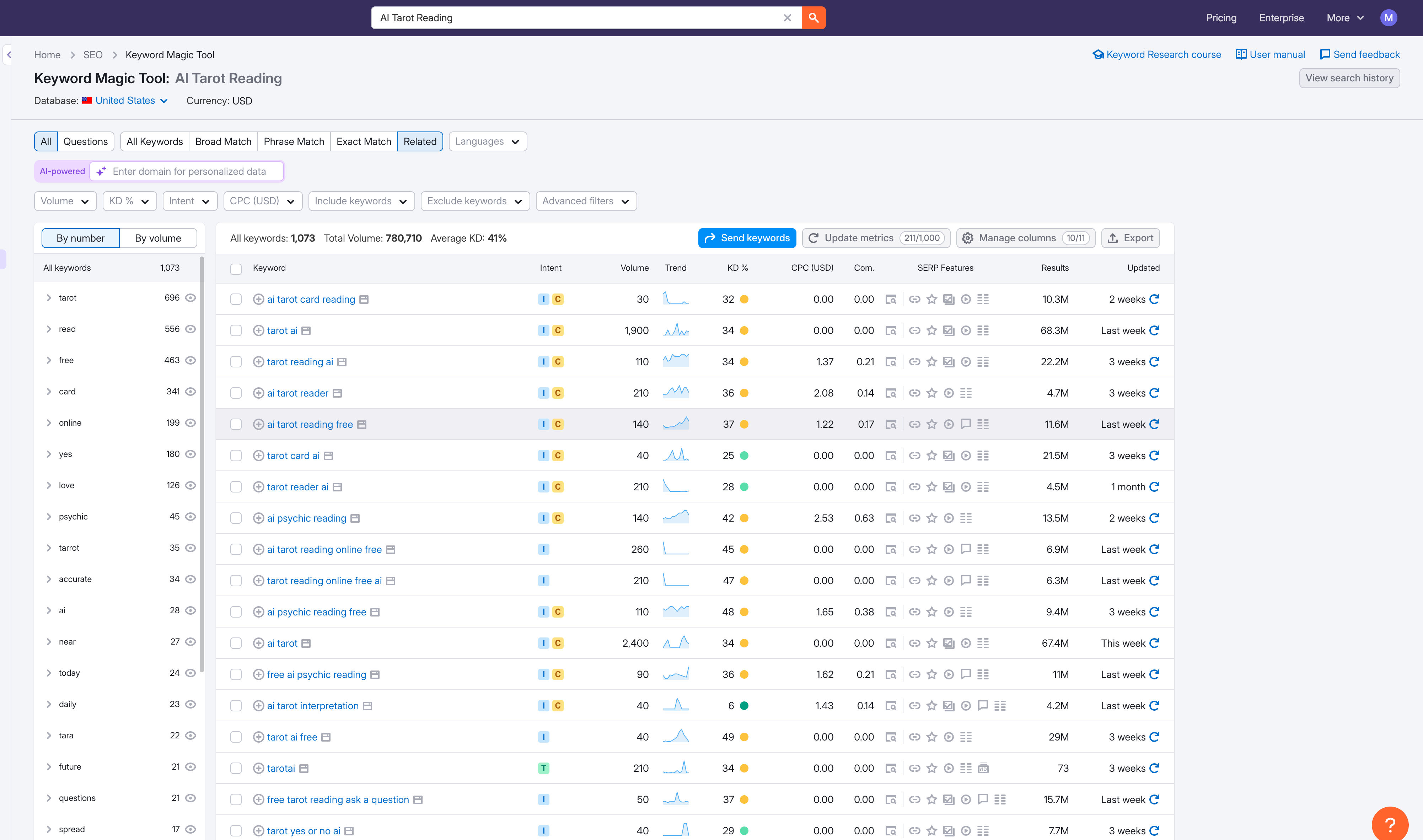
The core question everyone should think about when choosing is: How to choose words to make the article easy to write and natural? In fact, in the actual writing process, many words will be discarded, but the process of word selection is also a way to help you sort out the skeleton of the article.
Below are my word choices for AI Tarot Reading.
- Core keywords (Primary): AI Tarot Reading
- Secondary keywords: ai tarot reader, tarot reading ai, ai tarot card reading, tarot ai, ai psychic reading, ai tarot interpretation
- Long tail and semantic related words (LSI): ai tarot reading free, ai tarot reading online free, free ai psychic reading, tarot ai free, accurate tarot reading free, best free tarot reading, tarot yes or no ai
2. Title and description of the article
Title
First of all, the big title of H1 should be consistent with MetaTitle. MetaTitle is the title displayed in Google search results and is the first factor that determines whether the user clicks. The quality of the title directly affects the click-through rate (CTR), and CTR is one of the important signals of the Google ranking algorithm.
My title is called AI Tarot Reading 2025: Your Future. This title contains several key elements:
- Main Keyword: AI Tarot Reading (AI Tarot Card Divination) is the core keyword we hope to rank for
- Timeliness Mark: The year 2025 indicates the timeliness of the content
- Guide word: Your Future directly establishes a personal connection with users
The timeliness of content has always been one of the factors in ranking articles in search engines. By including the year in the title, we communicate to Google and users the freshness of the content.
When constructing SEO titles, we can follow the following principles:
- Concise and clear: The title should be controlled within 60 characters to ensure that it is fully displayed in the search results.
- Include main keyword: Try to put the main keyword in the front of the title to increase the weight of the keyword
- Use Numbers: Numbered titles such as "7 Ways", "5 Steps", etc. usually get higher click-through rates
- Ask a question or solution: like "How to...", "Why..." or "A complete guide to..."
Here are several templates for effective SEO titles:
-
[number] + [adjective] + [keyword] + [year]Example: 7 Best AI Tarot Reading Tools 2025 -
How to [action] + [keyword] + [benefits]Example: How to Use AI Tarot Reading for Accurate Life Predictions -
[Keyword]: [Subtitle Explanation Value]Example: AI Tarot Reading: The Ultimate Guide to Digital Divination -
[verb] + [keyword] + [time frame]Example: Master AI Tarot Reading in Just 10 Minutes a Day
Description
The description here mainly refers to MetaDescription, which is a summary in Google search results and is a general description of the article content. I understand it is the part that further convinces the user why they clicked.
My description is Explore AI Tarot reading in 2025! Discover how AI blends ancient wisdom with modern tech for insightful, accessible guidance on your life's path.
This description has several advantages:
- Contains keywords: AI Tarot reading is naturally integrated into the description as the main keyword
- Timeliness: mentioning 2025, emphasizing the timeliness of the content
- Value Proposition: Clearly expresses the core value of AI Tarot (combining ancient wisdom and modern technology)
- Emotional connection: Mention "your life's path" to establish a personal connection with the reader
- Call to Action: Begin with "Explore" and "Discover" to encourage users to click
- Moderate length: About 150 characters, fully displayed within Google display limit (155-160 characters)
A valid Meta Description should:
- Concise and to the Point: Summarize the core content of the article within 155-160 characters
- Include keywords: Naturally integrate primary keywords and secondary keywords
- Highlight Value: Clearly express what users can gain from the article
- Contains a call to action: such as "Learn", "Discover", "Learn", etc.
- Complementary to title: Provide additional information beyond the title
- Avoid duplication: Do not simply copy the title content
Here are several templates for effective SEO descriptions:
-
Question-answering type: Template: "Want to know how [keyword] can [solve problems/achieve goals]? This article explains in detail the [features/methods] of [topic] to help you [get benefits] and eliminate [pain points]."
Example: "Wondering how AI Tarot cards can accurately predict your future in 2025? This article details the latest AI divination technology, helping you gain personalized life guidance without feeling lost."
-
Number list type: Template: "Explore [year/time] [number] big [adjective] [keyword] and compare their [feature 1], [feature 2] and [feature 3]. Find the [product category] that suits you best and turn on [positive results]."
Example: "Explore 2025's top 5 AI Tarot tools, comparing their accuracy, usability, and personalization features. Find the digital divination assistant that's perfect for you and begin your journey of intelligent prediction."
-
Comparative advantage type: Template: "[Traditional Method] vs [New Method]: [Year/Time] [Keywords] How can you beat [Old Way]? Learn how [New Method] can provide more [Comparative Advantage 1], more [Comparative Advantage 2] [Results], [Additional Benefits]."
Example: "Traditional Tarot vs AI Tarot: How does digital divination in 2025 surpass conventional methods insights? Learn how AI delivers more accurate, more personalized life guidance with spiritual available anytime, anywhere."
-
FOMO trigger type: Template: "[Year/Time][Keyword] is revolutionizing [Industry/Event]. Don’t get left behind! Learn how the latest [Technology/Methodology] can [Unique Selling Point] provide [Unique Benefits] for your [Need]."
Example: "2025 AI Tarot technology is completely transforming divination practices. Don't fall behind! Discover how the latest AI combines ancient wisdom with quantum computing to provide unprecedented insights for your decision-making."
-
Problem Solving Type: Template: "Facing [common problem]? Our [year/time] [keyword] guide offers [number] proven solutions to help you [achieve your goals] and avoid [common mistakes]."
Example: "Facing life decision challenges? Our 2025 AI Tarot Guide offers 7 proven analysis methods to help you make wise decisions and avoid common judgment errors."
-
Expert and authoritative type: Template: "A complete guide to [year/time] [keywords] based on [data source/research]. Our [experts/team] analyzed [number] cases to reveal [insights/trends] in [industry]."
Example: "Based on 10,000 real predictions, the complete 2025 AI Tarot guide. Our data scientists analyzed 500 successful cases, revealing breakthrough accuracy in digital divination."
-
How to Guide Type: Template: "How do you master [keyword] in [timeframe]? A step-by-step guide takes you from [starting state] to [desired results], including [featured content] and [unique resources]."
Example: "How to master AI Tarot reading in 7 days? Step-by-step guide takes you from beginner to professional reader, including interactive exercises and expert video commentary."
-
Statistical data type: Template: "[A surprising number] of people are using [keyword] to [achieve goals]. Discover why [product/service] has achieved [percentage] satisfaction in [year/time], and how it’s changing [industry/campaign]."
Example: "87% of people are using AI Tarot to guide important decisions. Discover why 2025 digital divination tools achieve 93% accuracy and how they're transforming how modern people seek guidance."
3. Article content
A high-quality SEO article needs to meet the requirements of search engines while providing truly valuable content to readers.
This part is very dependent on localized writing experience, because everyone’s native language is not English. If it is handwritten or refined, after all, the best way is to write paragraphs in Chinese and integrate English keywords.
Writing methods for novices
Let me use a quote as an example. This is the most original AI-generated quote:
As we navigate the ever-evolving landscape of 2025, the ancient art of Tarot is experiencing a fascinating renaissance, seamlessly blending with cutting-edge artificial intelligence.

Many are asking: can AI truly interpret the wisdom of the Tarot, and what does this mean for our personal journeys?

This year, AI-powered Tarot readings offer a unique, accessible, and surprisingly insightful window into the energies shaping our lives, providing guidance for the challenges and opportunities that lie ahead.
Translated into Chinese is:
As we navigate the evolving landscape of 2025, the ancient art of tarot is experiencing a fascinating renaissance, seamlessly integrating with cutting-edge artificial intelligence.

Many people are asking: Can AI really interpret the wisdom of tarot cards? What does this mean for our personal journeys?

This year, AI-driven tarot readings provide a unique, accessible and surprising window into the energies that shape our lives, providing guidance on the challenges and opportunities we face.
Writing with keywords:
As time goes by, AI can handle more and more complex scenes and cover more traditional scenes, and AI Tarot is one of them.

Many people will ask: Is AI Tarot reading really useful? Is AI Tarot Interpretation effective?

Obviously Tarot AI is useful, and based on traditional tarot card readings, it can provide more insights and help people better understand and make decisions.
Translated into English (AI keeps keywords):
As technology advances, AI has become capable of handling increasingly complex scenarios and has expanded into many traditional fields, with AI Tarot being one of the examples.

Many people ask: Is AI Tarot reading actually useful? Can AI Tarot Interpretation be effective?

Clearly, Tarot AI is indeed valuable, and beyond traditional tarot card readings, it can provide deeper insights, helping people better understand their situations and make more informed decisions.
Novice writers can just write like this, directly generate it with AI first, then translate it, complete the reconstruction of the entire article with Chinese and English keywords, and then translate it back to English.
After you are familiar with the writing, and your English is a little better, AI will generate it directly, and the modification is actually very fast.
Only a small number of selected articles need to be edited in this way
Keyword distribution and density
Review the keyword strategy~
-
Main Keyword Strategy:
- "AI Tarot Reading" appears in the H1 title, introduction, beginning of each H2 section, and conclusion.
- Its density is kept at around 1-2%, which not only ensures relevance, but also avoids the suspicion of keyword stuffing.
- Variants (e.g.
AI tarot readings,tarot reading with AI) are naturally distributed in the text.
-
Secondary Keyword Strategy:
- Each secondary keyword (e.g. "AI tarot reader", "tarot AI") appears naturally in the section of content to which it is most relevant.
- They are used as part of subheadings or key sentences, enhancing the thematic depth and semantic relevance of the page.
-
Long-tail and semantically related word strategies:
- Long-tail keywords (such as "free AI tarot reading", "accurate AI tarot reading") are mainly used in highly targeted titles and content to accurately match user intent.
- For example, focus on long-tail words related to “free” when discussing free resources, and focus on using words related to “accurate” when discussing accuracy.
End
Everyone must try this more often!